

The Adding Machine and the Analyst
Or how AI is replacing the parts of research that should never have been done by humans.

Picture a counting house in 1885. Thirty young men sit elbow to elbow, copying figures from one ledger to another. The air smells of ink and sweat. A single transposition error, a seven mistaken for a one, can take hours to find. These men are not paid to think. They are paid not to make mistakes.
Then, William Seward Burroughs produces a machine that adds with perfect consistency. It does not lose focus. It does not transpose sevens after lunch. It simply works. And thirty men who defined their professional worth by the steadiness of their hands are suddenly in trouble.
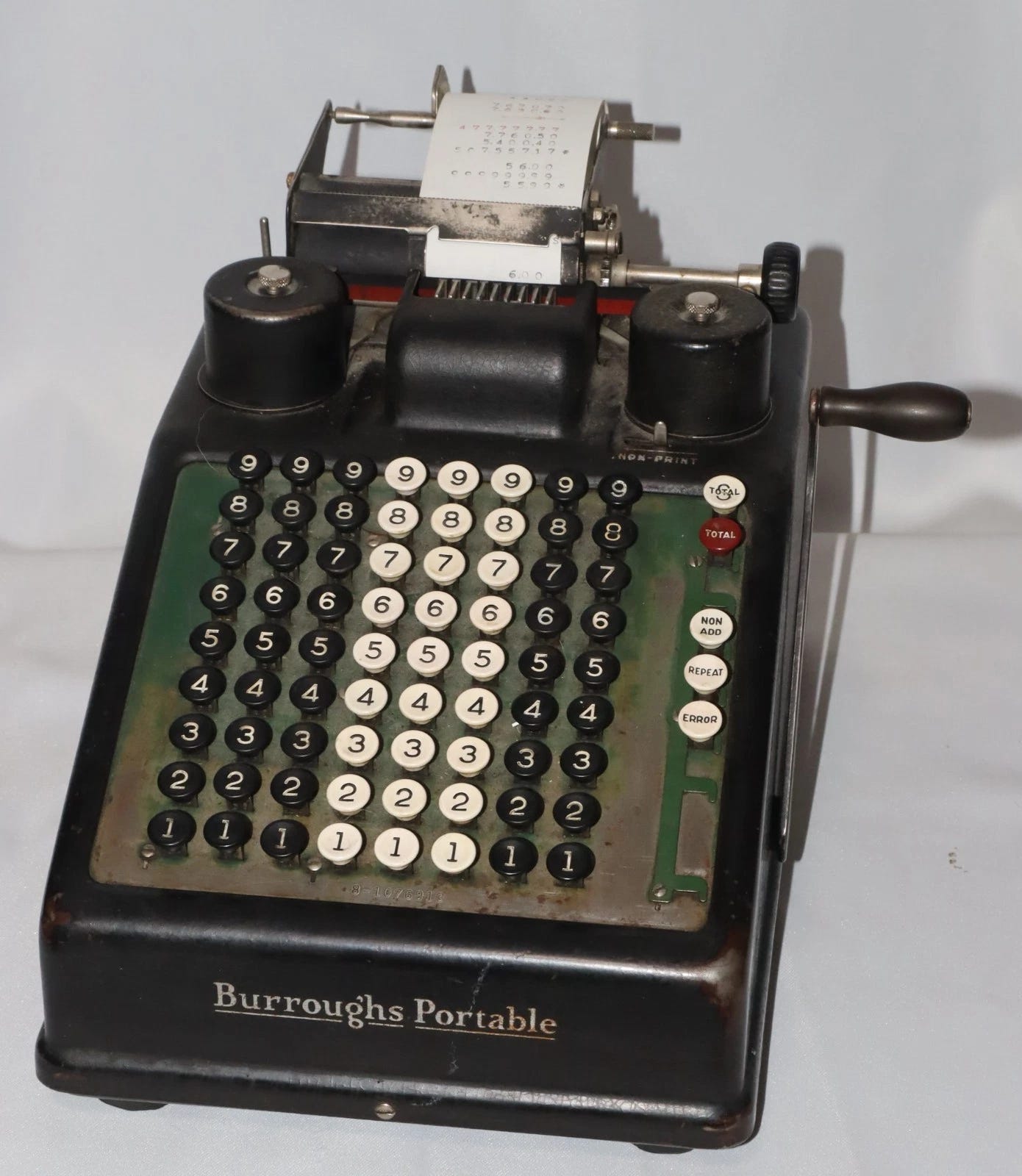
Market researchers should find this story uncomfortably familiar.
The Quiet Infrastructure
Most research teams still run on the same operational backbone that has existed for decades. Someone writes a questionnaire. Someone codes the data. Someone produces the tables. Someone reads the tables and turns them into a narrative. None of this is glamorous. All of it takes time. And nearly all of it is now automatable.
In recent posts, I have argued that AI is already capable of removing most of that operational drag. Not in theory. In practice. It can write surveys from briefs, summarise datasets fluently, code open-ended responses without supervision, generate synthetic data to explore hypotheses, and produce first drafts of reports that are clearer than many human ones. It can answer questions about a dataset conversationally, without an analyst as intermediary.
AI has become a machine for analysis in the way Burroughs built a machine for arithmetic.
And just like nineteenth-century clerks, researchers are responding with familiar arguments. It is not accurate enough. It misses nuance. Clients will not trust it. The human touch matters. All of these points contain some truth. None of them changes the direction of travel.
What Burroughs Actually Changed
The adding machine did not eliminate accounting. It eliminated the tedious part of accounting and forced the people doing it to move up the value chain. Clerks who embraced the machine became accountants. Clerks who clung to the ledger were laid off.
The same transformation is waiting for research. AI does not replace humans. It replaces tasks that were previously done only by humans because there was no alternative. And once those tasks disappear, the role itself begins to look different. The future is not one with fewer people. It is one in which people stop spending their energy on work that machines can now do more reliably.
Burroughs ushered in modern finance. AI is about to usher in modern insights.
The Fear Isn’t About Performance
Clerks feared the adding machine not because it failed but because it worked. It threatened their identity. When your value is defined by meticulous manual skill, a tool that performs that skill instantly feels like a personal insult.
Researchers are feeling a similar strain. If an AI can write a first draft of a report, that undermines the belief that report writing is craftsmanship. If it can summarise an entire dataset in seconds, that challenges the analyst's role. If it can ask probing follow-ups, that presses on the boundary of what counts as qualitative skill.
The fear is not about performance. It is about status. And confusing task automation with value automation is a mistake we keep making.
What Remains
Once the mechanical work disappears, what remains is the work that always mattered most. Thinking. Interpreting. Challenging assumptions. Understanding people. Applying context. Making strategic decisions. Telling stories that change minds.
These are not things AI takes away. They are things AI finally allows researchers to focus on.
Projects will move faster because they are no longer limited by human throughput. Budgets will stretch further because the operational layer becomes dramatically cheaper. Clients will receive deeper answers because analysts are not drowning in pre-analysis sludge. Creativity returns. Strategy returns. The job becomes more human as the workflow becomes less mechanical.
The Real Question
The adding machine did not replace clerks. It removed clerking. What emerged afterward was a profession with higher status and higher value.
AI will not remove research. It will remove researching-as-data-processing. And in doing so, it will let researchers become the strategic partners they have always claimed to want to be.
Burroughs’ clerks discovered that their future was bigger than their past once they stopped fighting the machine and started using it. The same opportunity is now sitting on every researcher’s desk.
The only question is who picks it up.