

What I got wrong

When I started writing This Has Happened Before, I had a thesis. It was clean, simple, and wrong.
My thesis was: the workers who embraced the new technology fastest won. The ones who resisted lost. Adopt early, win.
It took about three chapters of research to realize this was nonsense.
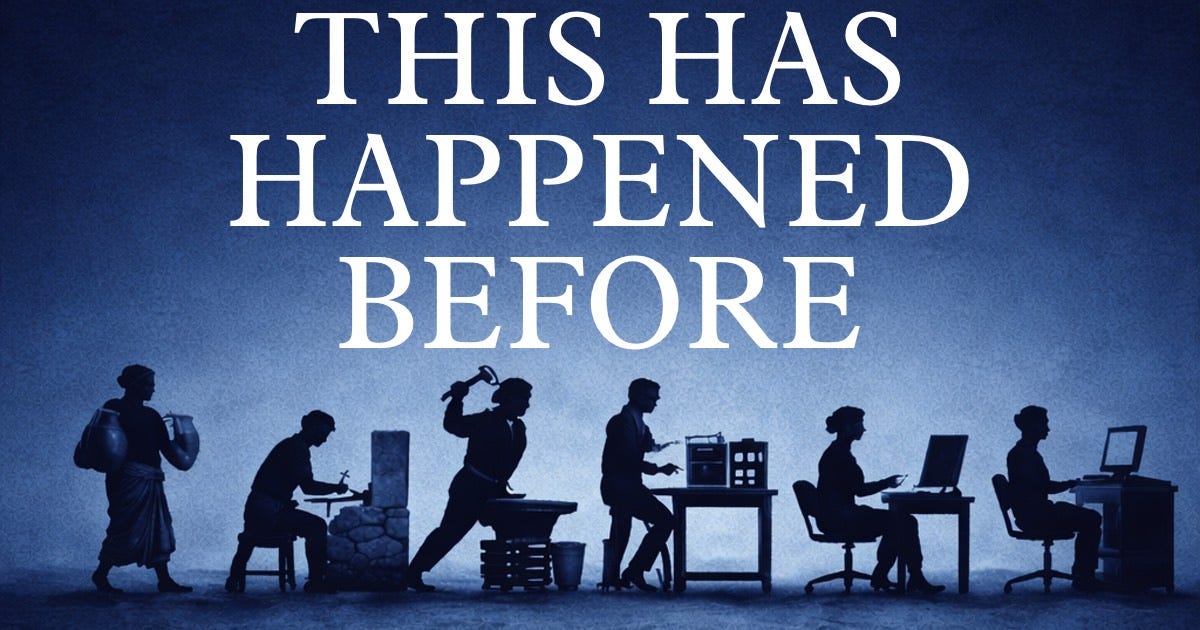
The adoption fallacy
Rachel, the accountant in Chicago, taught herself Lotus 1-2-3 in 1983 while her firm slept. She became a partner. That seems to confirm the thesis.
But then there’s Augusta, the compositor in New York in 1886. She learned the Linotype. Her wage increased. Her status solidified. The union made sure machine operators were well-paid union members. That worked for ninety years. Then phototypesetting arrived, and everything the union built became irrelevant.
Was Augusta an early adopter? Yes. Did it save her in the long run? The regulation bought her generation time. The next generation found the door closed.
And then there’s Thomas, the blacksmith in Illinois. He didn’t adopt the reaper. He didn’t learn to operate it. He noticed that it broke, and that farmers needed parts. He moved sideways into the ecosystem the machine created. His adoption wasn’t of the technology itself. It was an opportunity that the technology produced.
Early adoption wasn’t the variable. Strategic clarity was.
The real pattern
The more I researched, the messier it got. The workers who navigated disruption well weren’t defined by a single trait. They were defined by a combination of moves that looked different in each case but followed a similar logic.
They assessed honestly. Shamash-iddina, the cuneiform scribe, saw a merchant reading a contract in twenty-two characters instead of six hundred. He felt contempt. But he also understood exactly what he was looking at. The alphabet was simpler. It would spread. His reaction was emotional. His assessment was accurate.
They identified their residual advantage. Not their whole skill set. The specific parts of their expertise that the technology couldn’t replicate, and the market still valued. This was always a smaller slice than they wanted. Shamash-iddina ended up teaching priests’ sons. His map got smaller, but he stayed on it.
They repositioned around the residual. Instead of defending their old role, they built a new one around the pieces that still had value. Janet, the travel agent, didn’t fight Expedia. She went upmarket, building on taste, relationships, and judgment. Her revenue shrank. But it survived.
And they did all of this before they had to. That was the hardest part, and the most consistent predictor of success. The people who repositioned from a position of strength had dramatically better outcomes than those who waited for the crisis.
The postscript
After nineteen stories, here’s what I found when I laid them side by side:
The displacement is never instant. The shaduf took centuries. The Linotype took ninety years. Even the travel agents took a decade. The speed varies enormously. The direction does not.
The people who came through were not the ones who correctly predicted the future. They were the ones who moved before they had complete information.
Nobody came through unchanged. Thomas lost his identity as the town’s only blacksmith. Dorothy became a maintenance technician. Janet went from 500 clients to 150. The pivot works. But it costs something. The stories that get told about transitions tend to skip this part.
And some people had no viable path at all. Kha didn’t become an overseer. Eleanor didn’t learn to program. Having the right skills was necessary but not sufficient. You also needed proximity, timing, visibility, and luck.
I wrote the book for the person sitting at their desk on a Tuesday morning, watching AI tools get better month by month, wanting something more substantial than hot takes or reassurance.
The record isn’t comforting. But it’s clarifying. And right now, clarity is worth more than comfort.