


Kha fills the bucket at the canal’s edge, lifts it to his shoulder, and climbs. Thirty paces up a shallow slope to the garden terrace. Fifteen liters. By the time he reaches the top, water has sloshed over the rim and soaked the left side of his kilt. He tips what remains into the irrigation channel and turns back down.
He has worked this estate on the Nile’s west bank since he was twelve. He is past thirty now, which on a Nile estate in the early Middle Kingdom makes him one of the older carriers. His shoulders are uneven. His knees ache before midday. But he knows which part of the canal runs cleanest after the flood recedes. He knows the date palms on the upper terrace need water three days before the onions because their roots sit in drier soil. No one told him this. He learned it by watching what wilted and what didn’t.
Then one day, a stranger arrives with a wooden pole on a pivot, a stone lashed to one end, a bucket on the other. A shaduf. Pull the long end down, and the bucket dips into the canal. Release, and the counterweight lifts the water. A child could work it.
Within a season, the morning shift drops from twenty carriers to eight. The eight who remain are not the strongest or most experienced. They’re the ones who happen to work sections the shaduf can’t reach.
This is the opening story of This Has Happened Before, and I started with it for a reason. The pattern it establishes is the pattern that repeats across four thousand years.
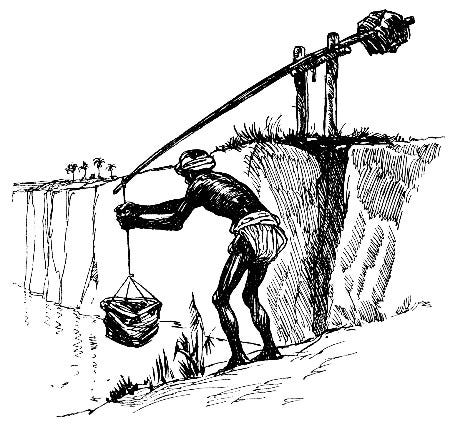
The gap between the headline and the reality
The shaduf arrived in Egypt around 2000 BCE, probably from Mesopotamia. A single device could move five to ten times as much water as a carrier with a bucket. The productivity gain was not subtle.
But here’s the part the economic histories skip: the transition took two to three hundred years. Shadufs spread first through Upper Egypt, along the major canal systems. Manual carriers persisted for generations in smaller holdings and remote fields. The workforce didn’t vanish. It shrank. And the roles that replaced it were different: water-scheduling officials, canal-maintenance crews, readers who measured the Nile’s height for tax and planting decisions.
The people who mattered most were no longer the ones moving water. They were the ones deciding where it should go.
This is the gap between the headline and the reality. The headline says “technology replaces workers.” The reality says the value shifts, visibly and permanently, toward the people who coordinate, schedule, and decide how the tool is used.
What Kha knew but couldn’t name
Kha knew which terrace to water first every morning. He’d been making that decision for eighteen years. But Senbi, the estate overseer, never asked him why. The gap between making good decisions and having someone notice you make them is why most carriers disappeared.
That gap is the cruelest part of every displacement story I found. The knowledge doesn’t vanish. The visibility does.
If your work involves assembling information that an AI can now assemble faster, you are Kha. If you write first drafts that a model can produce in seconds, you are Kha. This doesn’t mean your job disappears tomorrow. It means the part of your job that felt most like yours is no longer the reason anyone needs you.
What remains valuable is the knowledge that lives in experience. The small adjustments made without thinking. The decisions no one writes down because no one has ever had to. The oversight that keeps the system functioning, not just operating, but thriving.
But having that knowledge isn’t enough. You have to make it visible. Write down the parts of your job that require timing or context that isn’t captured in any system your organization uses. Not your tasks. Your decisions. The things you do that nobody asked you to do, but that make the work better.
That is where your value is moving, whether you move with it or not.
*This Has Happened Before: What Four Thousand Years of Displacement Can Teach You About AI* is available on Amazon: US | UK