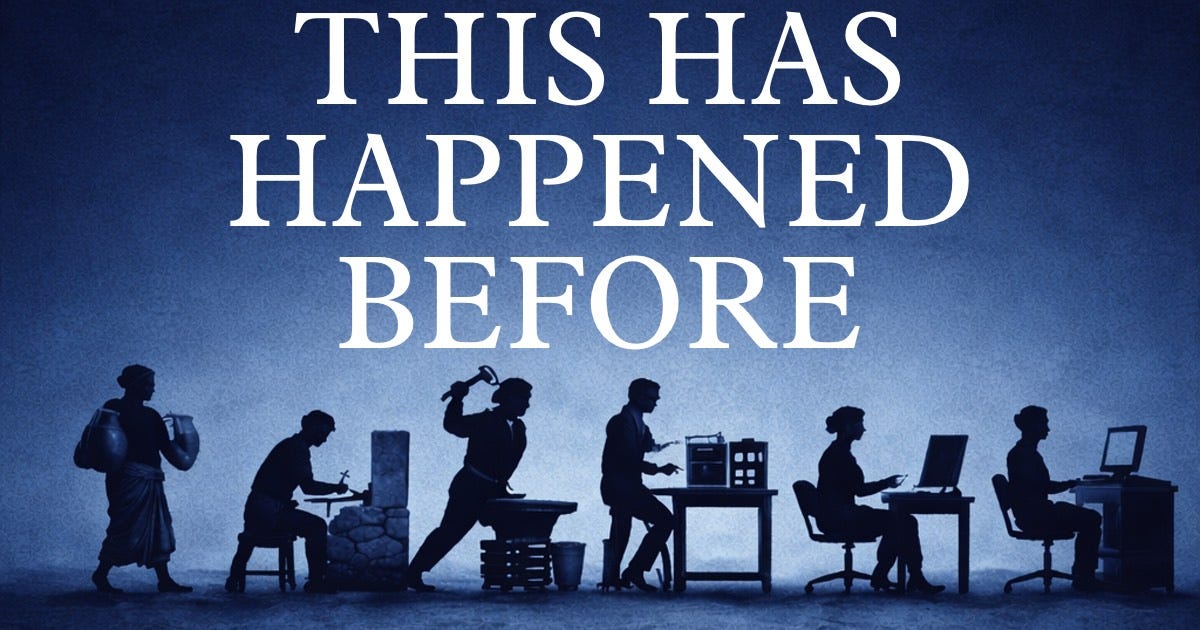
When "good enough" shifts underneath you
Or my return to the spinning jenny

One of the chapters in This Has Happened Before that I keep coming back to is Calverley, 1768.
Anne Booth sits in her cottage on Chapel Lane, spinning wool into thread. Her left foot works the treadle in a rhythm her body knows better than her mind. Through the thin wall, she can hear Margaret’s wheel running, and Margaret hears hers. The merchant pays six pence a day. The weavers want more thread than they’ve ever wanted before. Anne has no reason to think anything will change.
Then news of the Spinning Jenny arrives. A man can spin eight threads at once. In Lancashire, spinners break into the inventor’s house and destroy his machines. In Calverley, the reaction is quieter: skepticism, then cautious calculation.
Here’s the part that keeps me up at night.
For thirty years, old and new systems ran in parallel. Merchants bought from both. Some spinners operated jennies. Others kept hand wheels for fine work. Competition intensified, but work remained. The demand for thread was so great that surely there was room for both.
But wages started falling. Six pence a day in 1765. Three pence by 1790. One and a half pence by 1810.
The parish records tell the rest of the story. By 1800, spinners were increasingly rare. By 1820, they’re nearly gone. New notations appear: “spinner and laundress,” suggesting spinning alone could no longer sustain a household. Then: “pauper,” “able-bodied poor,” “seeking work.”
The window felt open the entire time. The demand for thread never stopped. What stopped was the demand for thread at a price that justified paying a person to produce it.
I call this the Yorkshire Question: when your premium is rising because the cheap alternative isn’t good enough *yet*, how do you know when “yet” is about to expire?
The spinners who thought quality would always protect them spent the premium years feeling safe. The ones who used those years to reposition, learn new machines, move into quality assurance, and find adjacent work came through.
For anyone whose AI-generated competition is currently at 70% quality: that percentage is a moving target. The market’s definition of “good enough” is about to shift underneath you.
The question isn’t whether the window exists. It’s what you’re doing while it’s open.
This Has Happened Before: US | UK